
The short answer
An electric tank heater has two thermostats, an upper and a lower, and each controls an element. When one fails, you get no hot water, lukewarm water or water that runs hot and then cold. Replacing a thermostat is a short repair for a plumber, and it can be done by a careful homeowner who follows the power-off steps.
If you are not comfortable working near high voltage, call a plumber. Water heater work involves 240 volt power, and a mistake can be fatal. This guide explains the job so you know what to expect.
Safety rules
Turn off the breaker for the water heater and confirm the power is off with a non-contact voltage tester before you remove any cover. Never work on a live heater. If the access panel is wet or the insulation is soaked, do not touch it and call a plumber.
Signs a thermostat has failed
No hot water at all
The upper thermostat or its high limit has tripped or failed.
Lukewarm water
The lower thermostat or element is not heating the bottom of the tank.
Water too hot
A thermostat stuck on keeps heating past the setting.
The breaker keeps tripping
A shorted thermostat or element draws too much current.
How to test before you replace
Power off
Switch off the breaker and verify with a voltage tester.
Open the panels
Remove the access covers and fold back the insulation.
Reset the high limit
Press the red reset button on the upper thermostat. If it clicks, restore power and test.
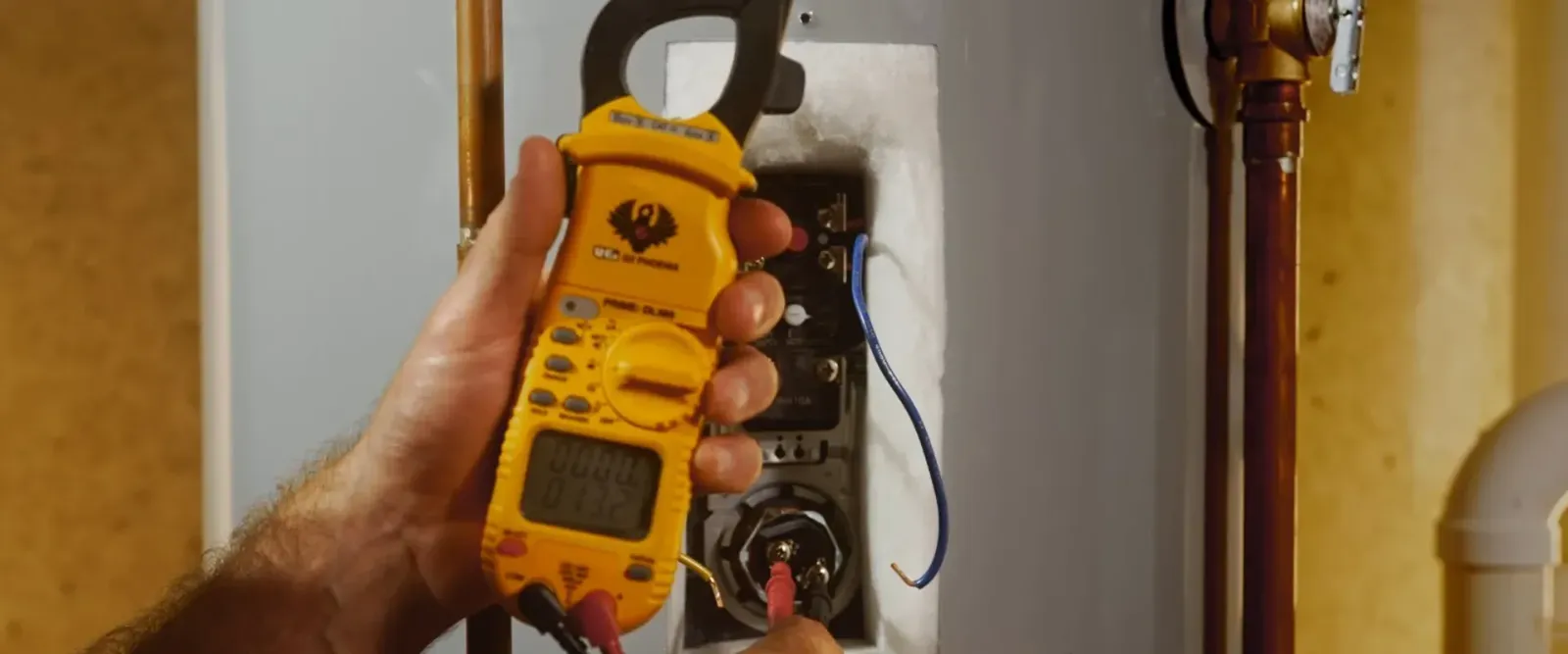
Test with a meter
A plumber uses a multimeter to check each thermostat and element for continuity.
Decide
A failed thermostat gets replaced. A failed element gets replaced too, since the two often wear together.
| Symptom | Likely part | Typical fix |
|---|---|---|
| No hot water | Upper thermostat or high limit | Reset or replace |
| Lukewarm water | Lower thermostat or element | Replace the part |
| Breaker trips | Shorted element | Replace the element, test the thermostat |
| Water too hot | Stuck thermostat | Replace the thermostat |
| Running out quickly | Lower element failed | Replace the lower element |
No hot water?
Call the 24/7 line about no hot water and we will book the next appointment that fits.
What the replacement involves
A plumber confirms the power is off, removes the old thermostat, fits the new one with the correct bracket and wiring and sets the temperature. We check the elements and the wiring at the same time, because a burned wire or a failed element is a common cause of repeat trips.
We then restore power, run hot water for a few minutes and check the temperature at a tap. If the tank is old, we tell you honestly whether a replacement makes more sense, and our water heater replacement page explains that choice.
What changes the cost
You hear a clear price before work starts. A single thermostat is a short job, and a full set of parts with testing takes longer.
The main factors:
Heater repairs are not usually an insurance matter. A failed heater that caused water damage may be, so ask your insurer.
Safe temperature settings
Most heaters leave the factory with the thermostat set at a temperature that is safe for most households, and many people turn it up without thinking. A higher setting raises the risk of scalds, especially for small children and older adults, and it wastes energy. A moderate setting gives hot water for showers and dishwashers and reduces risk.
If you need more hot water, raising the setting is not the right answer. A larger tank, a second element or a tankless unit solves capacity. If the water seems too hot even at a moderate setting, the thermostat may be failing.
| Setting | Effect | Note |
|---|---|---|
| Lower | Less risk of scalds, lower energy use | Check your dishwasher's requirement |
| Moderate | A comfortable balance for most homes | A common factory setting |
| High | Higher scald risk, more energy use | Not a fix for running out of hot water |
Check your water heater's manual for the recommended setting.
Replace the thermostat and the element together if the element is the same age and shows wear. They share a circuit, and a failing element is a common cause of a new thermostat tripping again. Ask your plumber to test both and explain what they found.
Write down the heater's model and serial number before you call. The label is on the side of the tank, and it lets a plumber bring the matching thermostat and elements.
Electric water heaters in Massillon homes
Massillon and Perry Township have a large share of older owner-occupied houses. Perry Township's plan counts about 12,577 housing units, around 78 percent of them owner-occupied, and many homes there are decades old. In houses with older wiring, a water heater circuit may be undersized or have aging connections, which shows up as a tripping breaker.
Electrical work beyond the heater, such as replacing a breaker or a circuit, is a licensed electrician's job. Plumbing and electrical permits vary, so ask the Massillon Building Department. Our Perry Township and Jackson Township pages list where we serve, and the water heater repair page covers gas models too.
Replacement parts must match the maker's specification for your model, and electrical work follows the standards that apply to your wiring.
Massillon thermostat questions
A plumber tests both with a meter. If the upper thermostat is bad, there is no hot water. If the lower element is bad, you get lukewarm water.
It can be a shorted thermostat or element. Do not keep resetting the breaker. Turn it off and call a plumber.
A higher setting raises scald risk and wastes energy. A safe setting is a better idea, and a bigger tank or a tankless unit fixes capacity.
Many last for years, and failure often shows as the heater gets old.
Yes. The line is open 24 hours a day, every day, and we book the next appointment.